
Showing posts with label Seamanship. Show all posts
Blocks and Tackles - Equipment On Board
The purpose of a block is either to change the direction of pull on a rope or else to act, in conjuction with other blocks as a tackle for reducing the pull required to lift or shift a heavy object. The essential part of a block is sheave.

The sheave or sheaves revolve on a pin, And the pin itself is supported by the shell. The Shell consists of two or more cheeks connected at top and bottom by distance so as to keep the cheeks sufficiently apart for the sheaves to be slipped in and a metal binding which provides an eye car hook at the top and a becket at the bottom.The top of the shell is called crown and its bottom is called tail.

Single Sheave: The single-sheave block has only one sheave and may or may not have a hook or becket.

The sheave or sheaves revolve on a pin, And the pin itself is supported by the shell. The Shell consists of two or more cheeks connected at top and bottom by distance so as to keep the cheeks sufficiently apart for the sheaves to be slipped in and a metal binding which provides an eye car hook at the top and a becket at the bottom.The top of the shell is called crown and its bottom is called tail.
Types of Blocks
There are several different types of blocks, below are some different types of blocks.
Single Sheave: The single-sheave block has only one sheave and may or may not have a hook or becket.
Clump Block
Built Block
External Bound Block
Internal Bound Block
Non Toppling Block
Gin Block
Coaling Block
Stropped Block
Tail Block
Hook Block
Binding
The binding has holes in each of its arm through which the pin is passed. Very small wooden blocks may not have the binding.In that case the outer cheeks are scored to take a strap for suspending the block. The space between the sheaves and the crown through which the ropes passes is called swallow. This block will take the rope one tenth the size of rope is measured by diameter in millimeters.
Tackles
A Tackle is a set of two single or multi-sheaved blocks with single continuous rope rove through both of them. Tackle are used to reduce the pull required to lift or shift a load.
For example: If ten men are required to drag a case of machinery across the deck, only two may be sufficient if a tackle is used.
One of the blocks is fixed to stationary point. It is called the standing block. The other block is called the moving block and it is hooked to the load which is to be lifted or shifted. The standing part of a rope is fastened to a becket in one of the blocks the other end of the rope is called the hauling part, running between the two blocks is called running parts.
Types of Tackles
Gun tackle. Place two single-sheave blocks about 3 feet apart with the hooks or straps facing outboard and both blocks in the same position, either on their face or cheek. Next, they should run the line through the first and second block, then splice it to the becket of the first block. Gun tackle has a 2 to 1 mechanical advantage.
Luff tackle. Position one single- and one double-sheave block in the same manner as with the gun tackle. Run the line through one of the sheaves of the double-sheave block first and then to the sheave of the single-sheave block. Next, run the line through the other sheave of the double-sheave block and splice the line to the becket of the single-sheave block. This tackle offers a 3 to 1 mechanical advantage.
Twofold purchase. Position two double-sheave blocks in the same manner as with the luff tackle. Reeve the line through the top or bottom block, stay in sequence, and never cross from one side to the other. After reeving the tackle, splice the standing line to the becket. Twofold tackle has a 4 to 1 mechanical advantage.
Double luff tackle. Obtain a double- and a triple-sheave block. Place the blocks 3 feet apart with the hooks or straps facing outboard and position the blocks so that one is face down and the other cheek down. When reeving a tackle that has one block with more sheaves than the other, always start with the block with the most sheaves. In this instance, start reeving through the center sheave, keeping the line parallel. Never cross from one side to the other. Double luff tackle has a 5 to 1 mechanical advantage.
Threefold purchase. Place two triple-sheave blocks 3 feet apart, with the hooks or straps facing outboard, positioning the blocks so one is face down and the other is cheek down. Start reeving in the center sheave of one block and finish in the center sheave on the other. Then splice the standing part to the becket. This tackle offers a 6 to 1 mechanical advantage.
Tools You'll Find Onboard Merchant Vessels
Here are some Tools you'll find on Merchant vessels, These tools are used for various tasks by ship crew.
1: Insulated Plier

2: Nose Plier

3: Hammer
 4: Lugg less Shackle

5: VHF Channel 16

6: Adjustable Spanner

7: Open End Spanner

8: Heart Shape Thimble eye

9: Bow Shackle

10: Bench Vise

11: Screw Drivers

12: Safety Harness

13: Safety Helmet
 14: Ullage Measuring Tape

1: Insulated Plier
2: Nose Plier

3: Hammer
5: VHF Channel 16
6: Adjustable Spanner

7: Open End Spanner

8: Heart Shape Thimble eye

9: Bow Shackle

10: Bench Vise

11: Screw Drivers

12: Safety Harness

13: Safety Helmet

Tag :
Seamanship,
Tools
Ropes Used on Merchant Vessels - Vegetable Fiber Ropes
This Article briefly describes Ropes used Aboard on Merchant vessels. We have covered ropes which are widely used. There will be 3 posts in this series, This is Part 1 and it will be covering vegetable fiber ropes only.
There are Three Major kinds of ropes used on board Merchant vessels and they are:
There are Three Major kinds of ropes used on board Merchant vessels and they are:
- Vegetable Fiber Rope.
- Steel Wire Rope.
- Synthetic Fiber Rope.
Vegetable Fiber Ropes:
Vegetable fiber ropes are made from the following materials;

1) Manila: The fiber is extracted from leaves of the ABACA Plant and is golden color. Manila ropes are strong and reliable used for mooring, slings, derricks etc.
2) Sisal: Sisal is a Pale Yellow in color like straw obtained from the leaves of Cactus. It is somewhat similar to manila rope.
3) Hemp: This fiber is obtained from Hemp plant, It is grey in color. It is used for signal, halyards, boat lashing and hand lead line.
4) Coir: This fiber is obtained from coconut. It is Husk brown in color. This rope has got lot of elasticity. Sometimes it is used as a part of towing spring.
5) Cotton: Cotton ropes are weak.
Care and Maintenance of Vegetable Fiber Ropes:
1) Vegetable fiber ropes get easily damaged by acid and alkaline substances.
2) A rope stretches under strain but regains its normal length when strain is off, Strain should be within limits.
3) Vegetable fiber ropes absorb moisture when wet and lose strength by around 25%
4) Wet Rope swells and shrinks in length during rain, fog, dew, slackening tight ropes and halyards.
5) If Vegetable fiber ropes are stored wet, It will soon mildew and rot.
6) Check diameter of rope before using.
Tag :
Ropes,
Seamanship
Some Useful Knots for Sailors
Ropes are used for many things on a ship, So a Good Sailor should be familiar with handling ropes, tying basic knots, bends, hitiches, splices etc. This is an important part of their job. Here are some basic useful knots for sailors.
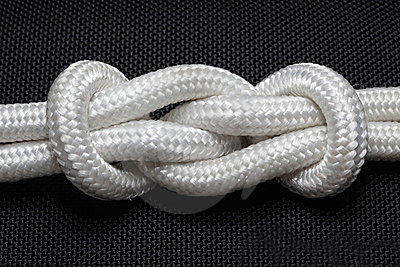
1: Bowline
A Bowline is used for many things for example, To fasten mooring to ring post. This knot does not slip under load and is easy to untie with no load.
2: Figure of 8 knot
Figure of 8 knot is Important for both sailing and rock climbing. A Figure of 8 knot can be used as a quick stopper. It also used to prevent it from unreeving through a block.
3: Reef Knot
4: Running Bowline
5: Bowline on Bight
6: Double Overhand knot
Tag :
Knots,
Seamanship
International Code of Flag Signals
 The International code of Flag Signals is very important if you want to pursue your career in merchant navy as a deck officer. The International code of flags contains 40 different flags.
- 26 - Alphabet Flags (A-Z)
- 10 - Numerals (0-9)
- 4 - Substitutes and Answer Flag.

A - Alfa Flag
Meaning:
Have a Diver Down, Keep Clear or me.

B - Bravo Flag
Meaning:
Dangerous Goods

C - Charlie Flag
Meaning:
Yes / Affirmative

D - Delta Flag
Meaning:
Maneuvering with Difficulty, Keep Clear.

E - Echo Flag
Meaning:
Altering my course to Starboard.

F - Foxtrot Flag
Meaning:
I'm Disabled, Communicate with me.

G - Golf Flag
Meaning:
I Require a Pilot
Fishing:
Hauling Nets

H - Hotel Flag
Meaning:
I have a Pilot on board

I - India Flag
Meaning:
Altering my course to Port

J - Juliet Flag
Meaning:
On Fire, Having Dangerous Goods, Keep Clear.

K - Kilo Flag
Meaning:
Wish to Communicate

L - Lima Flag
Meaning:
Stop Instantaly

M - Mike Flag
Meaning:
My Vessel has Stopped, Making No Way

N - November Flag
Meaning:
No / Negative

O - Oscar Flag
Meaning:
Man Overboard

P - Papa Flag
Meaning:
In Harbour: All Men Report on board.

Q - Quebec Flag
Meaning:
Request Free Pratique, My Vessel in Healthy

R - Romeo Flag
Meaning:
-

S - Sierra Flag
Meaning:
My Engines are going Astern

T - Tango Flag
Meaning:
Keep Clear, Engaged in Pair Trawling

U - Uniform Flag
Meaning:
You are Running into Danger

V - Victor Flag
Meaning:
Require Assistance

W - Whiskey Flag
Meaning:
Require Medical Assistance

X - Xray Flag
Meaning:
Stop Your Intentions, Watch for Signals.

Y - Yankee Flag
Meaning:
Dragging My Anchor

Z - Zulu Flag
Meaning:
Require a Tug
Fishing:
Shooting Nets

1
2
3
4
5
6
7
8
9
0

Substitute 1

Substitute 2

Substitute 3

Answer
Tag :
Flags,
Seamanship


